I’ve noticed that many of the links on this blog are dead. I’ll be going through the archives and trying to update them this next month or so.
The one that surprised me most - sort of - was that Bio Guard removed all of their Material Safety Data Sheets from their website. They didn’t just move them so that my links would be dead. They completely removed them and put a note, “To request MSDS for BioGuard products, please contact our BioGuard Customer Care by phone at 1.800.932.5943”.
Just a few months ago their entire library was available at their website. Now, they want to control who they release that information to. Why?
Perhaps it’s because they prefer that the public thinks their “essential minerals” in their Mineral Springs program are a “proprietary blend of minerals” instead of common salt and borax. Yes, the same Borax that Ronald Reagan used to shill for on Death Valley Days. I guess if you’re selling common salt and a laundry additive for something like $40.00 a 30 lbs. bag, you need to control who you release that information to.
You can achieve much the same results of a bag of Mineral Springs Beginnings with about $5.00 worth of salt (a forty lbs. bag at the Big Box store), a 4 lbs. box of sodium tetraborate decahydrate (20 Mule Team Borax) that sells for $2.99, and a little over a quart of muriatic acid to neutralize the borax.
If you use the median percentages for a bag of Renew it’s 2.4 lbs salt, about 7 ozs. of 20 Mule Team Borax, and 4 ozs. of liquid muriatic acid. That’s between $1.50 and $2.00, depending on where you shop. How much are you paying for Renew?
Here’s excerpts from an e-mail from a lady whose had quite enough of the whole Mineral Springs program:
“I stumbled across your blog as I was hunting for cheaper prices for Mineral Springs-Renewal that we have to put in our pool every week. I started reading all the articles and although I thought I was a fairly-informed consumer.
I can see I was totally wrong when it comes to these systems. So my question is--what now? Our pool was put in by [Big Pool Company], (Atlanta, Georgia area) in August 2007. We have had no troubles except now--trying to keep the PH low and the cyanuric acid up and the price of the Renewal--it is totally stupid--up to 26-30 dollars per week--no, I did not sign up for this! We take a pool water sample to our local [Big Pool Company] store in Loganville, GA and they test it for free--we never leave there without needing 90-150 dollars of chemicals.....
Our pool is still under warranty and after reading your articles and all the links--I want our of this system--any suggestions???? Any advise would be appreciated.”
$26 to $30 a week for $2.00 worth of salt and laundry powder... Think I’m making it up? Look again at the MSDS for Renew and do the calculations yourself. The “Inorganic salt” is salt. The Boron Salt is a product very similar to 20 Mule Team Borax. The Inorganic Acid is a granular acid to balance the pH from the high pH Boron salt (I substituted an equivalent amount of liquid muriatic acid in my calculations), and the Aluminum salt is just in there as a desiccant, to keep things dry. When you add it all up and replace with off-the -shelf bulk items, it comes out to about $2.00 for 4 lbs.
I’ve talked about all this before. Click on the Label Getting Screwed Buying Salt. It’s all there. And the BioGuard links have been Renewed, for a lot less than $30 a week.
Showing posts with label Getting Screwed Buying Salt. Show all posts
Showing posts with label Getting Screwed Buying Salt. Show all posts
Monday, May 12, 2008


Sunday, August 12, 2007
Soylent Green Is… Baking Soda
I admit it. I’m a Glass Half Empty kinda guy. The few rules I live by run in the vein that There’s No Free Lunch, Everything’s a Hustle, and that, like P T Barnum said, There’s One Born Every Minute. I’m the guy peering at the horizon searching for the Thunderhead behind the Silver Lining.
I didn’t start out this way. It’s just that I’ve been paying attention as I grow older. If you have even a moderately curious mind, and scratch even the surface of most things, you don’t have to dig very far to find out things like the Fajitas sizzle is just water and oil they spritz on the cast iron “sizzle platter” – yes, that’s what it’s called – before they bring it to your table.
Too, being a Pool Guy, I’m exposed to those kinds of hustles every day in my industry. Like the Soylent Green thing… I mean, the Total Alkalinity Control thing. About ten years ago, I was in a pool store and saw where their chemical supplier was boxing up sodium sesquicarbonate and telling their customers that they MUST USE this to adjust their Total Alkalinity. And the reason they did that was so they didn’t have to admit that you could go to the grocery store and buy boxes of Baking Soda off the shelf, and even in one pound boxes, the most expensive way to buy the stuff, you were going to save at least half over what they were asking.
Now, the real hustle part of that example is that Baking Soda is not only cheaper at the grocery store, but it’s more appropriate for raising just your Total Alkalinity. You see, Sodium Bicarbonate has a pH of 8.3, and sodium sesquicarbonate has a pH of 10.5. So, if you use the sesqui stuff, you’ll have to add some acid to bring your pH back down to normal, which will burn off some of that Total Alkalinity you just raised, so then you’ll have to add more sesqui stuff… hey, wait a minute. Maybe they’re on to something, huh? It’s an endless loop of making money off of misinformation.
The funniest part of that story is that the same pool store, which was part of a nationwide franchise for a particular chemical line, used to sell 50 pound bags of industrial grade Baking Soda to customers who knew enough to ask for it. They sold it for about $25 for the 50 pound bag. They sold a 12 pound box of the sesqui stuff for $18.99.
Here’s a couple of examples of the price differences between what a pool store will charge you and what you can get if you’re an informed consumer.
Leslie’s sells a 5 pound bucket of Baking Soda for $9.99. They’ll sell you a fifty pound bucket for $52.99. That’s as much as $2.00 a pound. It says right in the product description that Alkalinity Up is 100% granular Sodium Bicarbonate.
I’ve found one pound boxes of food grade Baking Soda in the grocery aisle for as little as sixty-eight cents a box.
But the price thing’s not the big issue here. Leslie’s is marking up Baking Soda nearly four times what you’d pay for even smaller quantities at the grocery store. But they’re not a nationwide supermarket chain. They’re a boutique. You knew they weren’t going to be cheap going through the door.
And, truth is, they’re at least admitting that they’re selling you Baking Soda.
Let’s look at another pool store chain. BioGuard sells their Total Alkalinity Control as a product called Balance Pak 100. Click Here for a link to their MSDS page. That’s Material Safety Data Sheets, in case you didn’t know. These are the government required ingredients sheets. They are outside the arena of sales and marketing and so explain what you’re really buying. Sort of like fajitas without the sizzle spritzed on. If you want to know what’s in something, ask them to see the MSDS at the point of sale.
But it seems they’re not selling Sodium Bicarbonate for Total Alkalinity Control. They’re selling Sodium Hydrogen Carbonate instead. Hmmm… if you scroll down to page 2, you’ll see it has a pH of 8.2, nearly identical to Sodium Bicarbonate and all the other information seems to be a mirror image of… Wait a minute. Look down there on page 3, under Transportation Information. Its proper shipping name is Sodium Bicarbonate. Baking Soda.
Do tell…
Sodium Hydrogen Carbonate is another name for NaHCO3; Sodium Bicarbonate, or Baking Soda. Did you know that?
Let’s look at another BioGuard program; Mineral Springs. Click Here. This is the Mineral Springs program description page. The way it works is they sell you an Aqua Rite chlorine generator that’s been private labeled for BioGuard as a machine that converts “essential elements” – read salt – into a sanitizer – read chlorine. The key to this program is that you buy bags that are 75% to 90% salt and 5 to 15% boron salts (probably sodium tetraborate pentahydrate since they own that patent) and then other inorganic acids to make the thing equal 100%, all for about $40.00 a 30 lbs. bag. I didn’t learn the true ingredients on the Mineral Springs page. I learned it by going to, once again, the MSDS.
Anyway, you need 1 thirty pound bag for every thousand gallons of water in your pool to get started on the program. If you have a 20,000 gallon pool, that’s $800.00 plus tax, just for the “essential elements”. Not to mention another $15.00 a week forever to add Mineral Springs Renewal. That's an additional $60.00 a month; $780.00 a year.
OR, you could go to Home Depot and buy 13 bags of salt pellets for about $4.90 a 40 pound bag, and about fifteen boxes of 20 Mule Team Borax (sodium tetraborate decahydrate) for about $2.90 a box, and a couple two gallon cases of acid for about $8.00 a case – you’ll need the acid to neutralize the 9.25 pH of the Borax. With tax, you’re out the door for about $135.00.
In California, due to the restrictions of selling borate products for use in swimming pools, BioGuard just sells you salt, 95 - 98%, with 1 - 2% Cyanuric Acid (commonly called Stabilizer) thrown in and still calls it Mineral Springs. That way, they can still call it "essential minerals”. The guy in the pool store pitching it to you knows all this, and he's able to stand there with a straight face and sell you about $3.75 worth of salt, with 0.3 to 0.6 lbs. stabilizer in it for significantly more than that. Here’s the MSDS for Mineral Springs in California.
If you think I exaggerate, if you think I paint too bleak a picture here, go back to the Mineral Springs program description page and use your browser’s Search function to search for the word Salt, or Saline, or Salinity, or Sodium Chloride, anything that might disclose that people are buying a regular old salt system.
No? No hits? Now go here, to the Mineral Springs Frequently Asked Questions and do the same thing. Same results, you say?
Do tell…
This whole program has done so much to prove that PT Barnum was just a Piker, that now Leslie’s has gotten into the act, teaming with Hayward/Goldline to private label their Aqua Rite and call it the Hayward Swim Pure Salt System. And guess what? They have companion products to go along with it. But you probably guessed that.
First, there’s Salt Water Magic Foundation. You need one, five pound container for every 5,000 gallons of pool water, and it only costs $34.99 per container. So, for that same 20,000 gallon pool, you’ll need $139.96 plus tax. You’ll still need salt, though. So, after your Home Depot run, you’ll be out another $63.70. Then, every time you add a make up bag of salt during the year, you’re supposed to add a container of Salt Water Magic Support, for $24.99.
That works out to be about $30 every time you add a bag of salt. And Leslie's is by far the less expensive salt water based program.
Hmmm… I thought these Salt Systems were supposed to eliminate all these extra costs. Instead, the manufacturers who got you to buy these Trojan Horses on the premise of saving you money have now teamed with the retailers to find ways to make this just another way of separating you from even more of your money.
You have to admit that if you listen to the Industry Experts, and follow their advice on what you ought to buy, you're going to be out a lot more money than if you'd stuck to your old chlrorine tab feeder and a bucket of shock.
Well, at least Leslie’s calls theirs a Salt System.
These are the kinds of Staring You Right In The Face If You Know Where To Look observations that make me that Glass Half Empty kind of guy.
The saddest part is, everything I've said is true.
I admit it. I’m a Glass Half Empty kinda guy. The few rules I live by run in the vein that There’s No Free Lunch, Everything’s a Hustle, and that, like P T Barnum said, There’s One Born Every Minute. I’m the guy peering at the horizon searching for the Thunderhead behind the Silver Lining.
I didn’t start out this way. It’s just that I’ve been paying attention as I grow older. If you have even a moderately curious mind, and scratch even the surface of most things, you don’t have to dig very far to find out things like the Fajitas sizzle is just water and oil they spritz on the cast iron “sizzle platter” – yes, that’s what it’s called – before they bring it to your table.
Too, being a Pool Guy, I’m exposed to those kinds of hustles every day in my industry. Like the Soylent Green thing… I mean, the Total Alkalinity Control thing. About ten years ago, I was in a pool store and saw where their chemical supplier was boxing up sodium sesquicarbonate and telling their customers that they MUST USE this to adjust their Total Alkalinity. And the reason they did that was so they didn’t have to admit that you could go to the grocery store and buy boxes of Baking Soda off the shelf, and even in one pound boxes, the most expensive way to buy the stuff, you were going to save at least half over what they were asking.
Now, the real hustle part of that example is that Baking Soda is not only cheaper at the grocery store, but it’s more appropriate for raising just your Total Alkalinity. You see, Sodium Bicarbonate has a pH of 8.3, and sodium sesquicarbonate has a pH of 10.5. So, if you use the sesqui stuff, you’ll have to add some acid to bring your pH back down to normal, which will burn off some of that Total Alkalinity you just raised, so then you’ll have to add more sesqui stuff… hey, wait a minute. Maybe they’re on to something, huh? It’s an endless loop of making money off of misinformation.
The funniest part of that story is that the same pool store, which was part of a nationwide franchise for a particular chemical line, used to sell 50 pound bags of industrial grade Baking Soda to customers who knew enough to ask for it. They sold it for about $25 for the 50 pound bag. They sold a 12 pound box of the sesqui stuff for $18.99.
Here’s a couple of examples of the price differences between what a pool store will charge you and what you can get if you’re an informed consumer.
Leslie’s sells a 5 pound bucket of Baking Soda for $9.99. They’ll sell you a fifty pound bucket for $52.99. That’s as much as $2.00 a pound. It says right in the product description that Alkalinity Up is 100% granular Sodium Bicarbonate.
I’ve found one pound boxes of food grade Baking Soda in the grocery aisle for as little as sixty-eight cents a box.
But the price thing’s not the big issue here. Leslie’s is marking up Baking Soda nearly four times what you’d pay for even smaller quantities at the grocery store. But they’re not a nationwide supermarket chain. They’re a boutique. You knew they weren’t going to be cheap going through the door.
And, truth is, they’re at least admitting that they’re selling you Baking Soda.
Let’s look at another pool store chain. BioGuard sells their Total Alkalinity Control as a product called Balance Pak 100. Click Here for a link to their MSDS page. That’s Material Safety Data Sheets, in case you didn’t know. These are the government required ingredients sheets. They are outside the arena of sales and marketing and so explain what you’re really buying. Sort of like fajitas without the sizzle spritzed on. If you want to know what’s in something, ask them to see the MSDS at the point of sale.
But it seems they’re not selling Sodium Bicarbonate for Total Alkalinity Control. They’re selling Sodium Hydrogen Carbonate instead. Hmmm… if you scroll down to page 2, you’ll see it has a pH of 8.2, nearly identical to Sodium Bicarbonate and all the other information seems to be a mirror image of… Wait a minute. Look down there on page 3, under Transportation Information. Its proper shipping name is Sodium Bicarbonate. Baking Soda.
Do tell…
Sodium Hydrogen Carbonate is another name for NaHCO3; Sodium Bicarbonate, or Baking Soda. Did you know that?
Let’s look at another BioGuard program; Mineral Springs. Click Here. This is the Mineral Springs program description page. The way it works is they sell you an Aqua Rite chlorine generator that’s been private labeled for BioGuard as a machine that converts “essential elements” – read salt – into a sanitizer – read chlorine. The key to this program is that you buy bags that are 75% to 90% salt and 5 to 15% boron salts (probably sodium tetraborate pentahydrate since they own that patent) and then other inorganic acids to make the thing equal 100%, all for about $40.00 a 30 lbs. bag. I didn’t learn the true ingredients on the Mineral Springs page. I learned it by going to, once again, the MSDS.
Anyway, you need 1 thirty pound bag for every thousand gallons of water in your pool to get started on the program. If you have a 20,000 gallon pool, that’s $800.00 plus tax, just for the “essential elements”. Not to mention another $15.00 a week forever to add Mineral Springs Renewal. That's an additional $60.00 a month; $780.00 a year.
OR, you could go to Home Depot and buy 13 bags of salt pellets for about $4.90 a 40 pound bag, and about fifteen boxes of 20 Mule Team Borax (sodium tetraborate decahydrate) for about $2.90 a box, and a couple two gallon cases of acid for about $8.00 a case – you’ll need the acid to neutralize the 9.25 pH of the Borax. With tax, you’re out the door for about $135.00.
In California, due to the restrictions of selling borate products for use in swimming pools, BioGuard just sells you salt, 95 - 98%, with 1 - 2% Cyanuric Acid (commonly called Stabilizer) thrown in and still calls it Mineral Springs. That way, they can still call it "essential minerals”. The guy in the pool store pitching it to you knows all this, and he's able to stand there with a straight face and sell you about $3.75 worth of salt, with 0.3 to 0.6 lbs. stabilizer in it for significantly more than that. Here’s the MSDS for Mineral Springs in California.
If you think I exaggerate, if you think I paint too bleak a picture here, go back to the Mineral Springs program description page and use your browser’s Search function to search for the word Salt, or Saline, or Salinity, or Sodium Chloride, anything that might disclose that people are buying a regular old salt system.
No? No hits? Now go here, to the Mineral Springs Frequently Asked Questions and do the same thing. Same results, you say?
Do tell…
This whole program has done so much to prove that PT Barnum was just a Piker, that now Leslie’s has gotten into the act, teaming with Hayward/Goldline to private label their Aqua Rite and call it the Hayward Swim Pure Salt System. And guess what? They have companion products to go along with it. But you probably guessed that.
First, there’s Salt Water Magic Foundation. You need one, five pound container for every 5,000 gallons of pool water, and it only costs $34.99 per container. So, for that same 20,000 gallon pool, you’ll need $139.96 plus tax. You’ll still need salt, though. So, after your Home Depot run, you’ll be out another $63.70. Then, every time you add a make up bag of salt during the year, you’re supposed to add a container of Salt Water Magic Support, for $24.99.
That works out to be about $30 every time you add a bag of salt. And Leslie's is by far the less expensive salt water based program.
Hmmm… I thought these Salt Systems were supposed to eliminate all these extra costs. Instead, the manufacturers who got you to buy these Trojan Horses on the premise of saving you money have now teamed with the retailers to find ways to make this just another way of separating you from even more of your money.
You have to admit that if you listen to the Industry Experts, and follow their advice on what you ought to buy, you're going to be out a lot more money than if you'd stuck to your old chlrorine tab feeder and a bucket of shock.
Well, at least Leslie’s calls theirs a Salt System.
These are the kinds of Staring You Right In The Face If You Know Where To Look observations that make me that Glass Half Empty kind of guy.
The saddest part is, everything I've said is true.
Saturday, October 14, 2006
WHY SALT SUCKS
So, do I have your attention now? Yes, I know. Cheap trick. But I’m trying to be combative here. Trying to get the juices flowing. Trying to get some FEEDBACK.
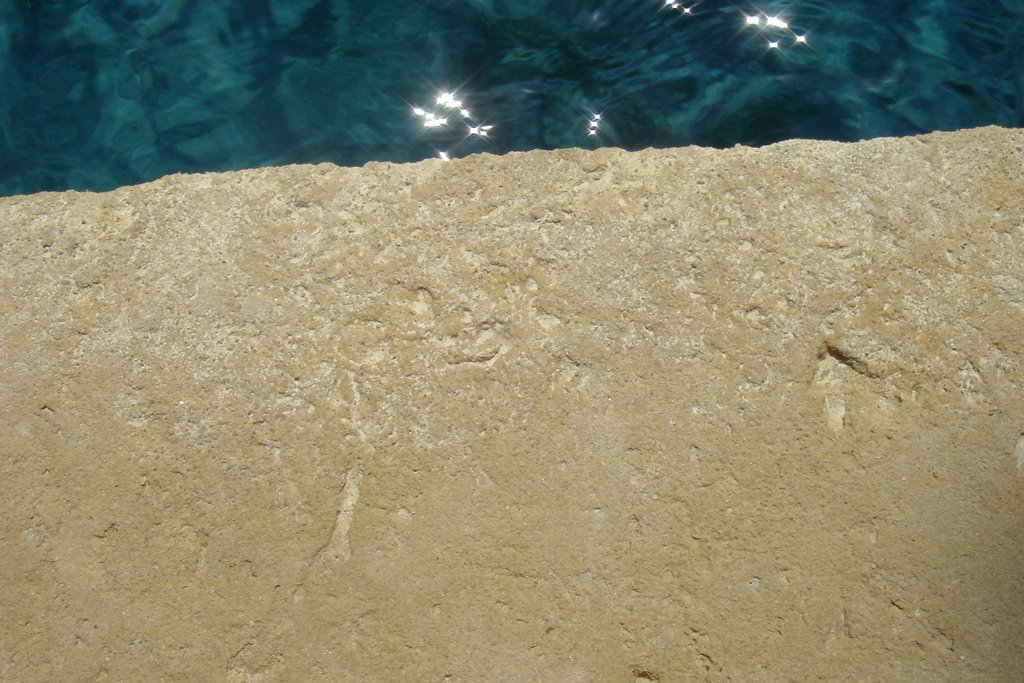
By the way, that's a picture of two year old limestone. Pretty, huh? It used to be, before the salt ate it.
Oh, and if you[re just tuning in, click on the September archive and read "salt belongs in the shaker, not the pool" first.
Is there no one out there who wants to defend these salt systems? No?
Good. I win. Remove them from all the pools and stop selling Pool Salt. God sakes. Do you believe it? Bags labeled Pool Salt.
"Our NaCl is better than the NaCl they sell at Home Depot. Sure, it costs more. But it’s better! Don’t use anything but genuine Pool Salt!"
Have we no shame?
But then, we mark up baking soda 1,000% and call it Total Alkalinity Control, so I guess we don’t. Yes, I know. It’s the box they’re paying $18.99 for. Not the 12 lbs. of baking soda inside.
I did receive one comment from my first post. Baboosa put me on to a new term; Galvanic Corrosion. And, boy, is it a duesy.
"Galvanic corrosion, often misnamed ‘electrolysis,’ is one common form of corrosion in marine environments. It occurs when two (or more) dissimilar metals are brought into electrical contact under water. When a galvanic couple forms, one of the metals in the couple becomes the anode and corrodes faster than it would all by itself, while the other becomes the cathode and corrodes slower than it would alone. Either (or both) metal in the couple may or may not corrode by itself (themselves) in seawater. When contact with a dissimilar metal is made, however, the self-corrosion rates will change: corrosion of the anode will accelerate; corrosion of the cathode will decelerate or even stop."
http://www.ocean.udel.edu/seagrant/publications/corrosion.html
Just so you know, most salt cell plates- or maybe all, I’m not sure - are made of titanium. Titanium is near the top of the chart for Cathodic metals. The cathode is the one that won’t corrode when galvanic corrosion takes place. So your salt cells are safe.
But it’s a good news / bad news kind of thing.
Copper, stainless steel and brass - or heat exchangers, filter tanks and water features, as I like to call them - are all pretty much anodic metals in relation to titanium. Remember now, the anode is the one that corrodes faster than it would if there weren’t any cathodic metals around.
You need three things for galvanic corrosion to occur. They are:
1. Dissimilar metals. We have that. Titanium salt cell plates and copper heat exchangers, for example. Or, titanium salt cell plates and stainless steel filter tanks, as another example. Or, titanium salt cell plates and brass pencil jets, or cannon jets, or high dollar sheer descents, to name a few. Brass is interesting in this scenario. It is made of zinc and copper. Copper is in about the middle of the galvanic index of metals. But zinc is all the way at the negative end, making it very susceptible to galvanic corrosion. That makes brass kind of ripe for this to happen. There’s something interesting about the titanium, too. It was chosen by the manufacturer because of it’s corrosion resistance (I read that in their sales brochure), because of it’s cathodic properties. Now, let’s add voltage to it. Does that make it more cathodic and speed up the whole process of galvanic corrosion for the anodic metals? Any science guys out there want to comment on that?
2. Electrical contact between the dissimilar conducting materials. It can be direct contact or a secondary connection such as a common grounding path. You know, like water as a grounding path.
3. Electrolyte (the corrosive medium) in contact with the dissimilar conducting materials. You know, like salt water.
Number three ought to keep any of you who thought you had me with, "then why haven’t stainless steel and copper galvanically corroded each other before salt systems came along?"
They would have. They were just waiting for the electrolyte to show up.
"Water is a compound that has strong ‘bonds’ among its constituents. In other words, it is difficult to break apart the hydrogen and oxygen atoms without some sort of energy input. ‘Salts,’ on the other hand, usually have weak ‘bonds’ and the atoms of salts can easily be separated into its appropriate ions. When a salt, like sodium chloride (table salt) is dissolved in water the sodium and chloride separate temporarily. The sodium atom will become a positively charged ion and the chloride atom will become a negatively charged ion. An ion is an atom or group of atoms that has a negative or positive electric charge. Negative ions are formed by atoms gaining electrons, and positive ions are formed by atoms losing electrons. Substances that conduct electric current are called electrolytes. They are formed as a result of a dissociation into positively and negatively charged particles called ions, which migrate toward and ordinarily are discharged at the negative and positive terminals of an electric circuit, respectively. The most familiar electrolytes are acids, bases, and salts, which ionize when dissolved in such solvents as water. Many salts, such as sodium chloride, behave as electrolytes when dissolved in water. Pure water will not behave as an electrolyte."
http://msnucleus.org/membership/html/k-6/wc/oceans/4/wcoc4_2a.html
Now, we should have known that. All of us. We should have known that the first time we poured salt into a pool we were creating a 20,000 gallon electrolyte battery.
You should have known it. I should have known it. We all should have known it.
Because if you cut and paste the link into your browser, you’ll see that the text description of electrolyte is from a fourth grade science experiment designed to teach ten year olds "that the ions in the water make salt water an electrolyte. An electrolyte is a nonmetallic electric conductor in which a current is carried by the movement of ions". In the experiment, the children observe that as they begin to add salt to the water, the water begins to conduct electricity, and the light begins to glow. The more salt they add, the more brightly the light glows.
Now that we’re all properly embarrassed, go back to the last sentence in the description of an electrolyte: Pure water will not behave as an electrolyte. Granted, our pool water is far from pure, but the old NSPI guideline limits TDS to 3000 ppm. Tap water ranges from 250 to 600 ppm. The highest I ever saw was 465 ppm out of the tap in El Cajon, CA. But I’m sure there’s harder water than that out there. The point being, we used to drain pools when they started approaching 3,000 ppm TDS. That’s where we start talking with salt systems.
Hence this discussion about galvanic corrosion. It was never an issue before. Now it is.
For example: Everybody knows by now, even those who defend salt systems, that you ought not to install a stainless steel DE filter tank where you have a salt system. I believe that more than half the reason is galvanic corrosion. I think another part is a little known issue called chloride stress corrosion, a problem unique to stainless steel, pressure, high water temp and brine, but we’ll talk about that at another time. Back when this whole salt craze started, I had a brand new pool on service that had a salt system and a stainless steel filter tank. The tank had pinhole leaks within ten months. Another one, a painted stainless steel tank (betcha can't guesswhich one) lasted a full year before it started weeping at the welds.
On the other hand, I have pools on service that are so old that a few still have American Products Titan stainless steel DE filters, but no salt system. Twenty years later, the tanks are just fine.
When you rule out stainless steel filter tanks, you automatically rule out 72 square foot DE filters and give up 12 square feet of filtration area. Because the largest non-corrosive DE filter tank is 60 square feet.
Now, if you’re a good and conscientious builder, you know that anything larger than a 2 horsepower pump will eventually crush those grids, and in some installations, even just 2HP is going to cause premature deterioration of the grid pack.
But your customer is adamant about having a salt system - because his best buddy does and the water feels so totally cool - and at the same time he really wants those spa jets to sing and dance, and you’re trying to squeeze in all the water features that he wants on that single filter pump and still keep your bid right so that you don’t lose the work to the competition who doesn’t care about pump and filter sizing.
Of course, if you take salt out of that equation, the problem goes away.
Further, I believe that the recent attempt to introduce cartridge DE filters - where you can get up to 100 square feet of DE filter area in a plastic tank - has been driven by the problem of salt and stainless steel.
Talk around the campfire is that we are probably in for a bit of a wait before they get the kinks worked out of cartridge DE filters.
Once again, though, the way we’re finding out that there’s a problem is by buying them, selling them, installing them and then spending all of our profit on complaint and problem calls, not to mention being totally defenseless when the customer asks, "didn’t you check this thing out at all before you sold it to me?"
But the salesman said...
At least with something like a filter problem, the worst case scenario is installing a different filter and a little bit of vacuuming to suck up the DE that blew into the pool when the cartridges crushed.
With salt, and a litigious consumer, you’re looking at the possibility of being on the hook for failed filter tanks, crushed grid packs, salt damaged coping and decks, failed copper heat exchangers, deteriorating brass water features that put metals into the pool water that will eventually plate out, and subsequent acid washes or replastering. High concentrations of salt will also kill trees and most any other type of vegetation and erode the soil (see my first post: salt belongs in the shaker, not in the pool). If you’re the one that installed the sticky water leveler and the salt system, are you liable for the damages?
Or maybe we should just sell them where they’re appropriate. You know, like for a pool that uses no concrete (salt water freeze/thaw issues), or stone (deterioration issues), or metal (galvanic corrosion issues), or is surrounded by soil, or plants or trees (environmental issues), or backwashes to the sewer (waste treatment salinity issues), or backwashes to the street (once again, environmental issues), or ever has to be drained to the sewer or the street (the same waste treatment and environmental issues).
We can, of course, just keep selling salt systems, and when things go south, keep walking away. That seems to be most folks answer. Because the truth is most customers don’t litigate. They just say bad things about us until they die. But it seems like these kinds of things just keep happening over and over and over again in our industry. Things like that first generation salt system that used to blow up if you left it unattended for too long, or the ionizers that turned pools copper green and purple, or pencil thin filter tank clamps that aged and blew the lids off and into people’s faces, or single source drains in spas, or... do I need to go on?
Maybe that’s why most homeowners and the other trades look at us like the Corky’s of the construction and service industries.
Maybe if we stop letting greed and avarice cloud our minds, and maybe if we stop looking to the manufacturers for pat answers instead of fixes, and maybe if instead we ask more hard questions up front before we buy to resell...
Yeah, right. And maybe bats will fly out of my butt.
Subscribe to:
Posts (Atom)