Sunday, October 29, 2006


Res Ipsa Loquitur


I have always held that every event in life - every action, every thought, every feeling - has already been played out in a movie somewhere. And if you’ve seen too many movies - like I have - then as your life unspools, the scenes of your life seem to play out as re-enactments from this or that movie.

This week, I’m blessed with playing Robert Redford’s Bob Woodward to the elusive Baboosa’s Deep Throat. Remember? Hal Holbrook’s parking garage freak? Then again, maybe I’m Dustin Hoffman in this scene. Because, unlike Woodward, I don’t know who Baboosa is. I just know he comes in the night and whispers in my ear.

“Galvanic corrosion.”

“Zinc Chloride.”

“Follow the money... What’s that noise? Are you sure you weren’t followed? ” and when I look back, he’s gone.

So, this week, we’re chasing leads to see where zinc chloride takes us, and learning lots along the way. I’m reminded of a much younger - nineteen year old - Navy Guy me, with my buddy, Tee Newman, crawling around in the slippery, slimy free flood areas to inspect the Zincs while we were in dry dock. I remember not even being sure what it was we were supposed to be looking for. But Tee had inspected Zincs before. You see, Tee lived and thrived in the rarified air that the Navy reserved for screw-ups. He always got jobs like this. I was pretty new to screwing up, but I was finding it to be a comfortable, less hurried place to be. Like this Zinc job. It may have been slimy and nasty, but once we disappeared into the free flood, as far as our Chief was concerned, we were out of sight and out of mind. And to Tee’s way of thinking, out of sight and out of mind was where he planned on us staying the rest of the day.

The vague directions the Chief had given us were that if the Zincs looked too corroded, then we were to put in a work order to get them replaced. We took chisels and mallets with us to scrape and pound the white clumps off the big Zincs so we could see how much metal was left under all the corrosion.

Ah, yes. The white clumps. I remember Tee telling me, “Don’t get any of that white stuff in your eyes. It burns like a....” Well, you know. Swear like a sailor, and all that. And when we got down to it, there were lots of white clumps. Lots and lots of white clumps. It turned what I thought was going to be an easy, cruise kind of day into an itchy, scratchy, crappy kind of day that had me rethinking the merits of Screwing Up versus Doing What You’re Told.

The reason it turned into an itchy, scratchy kind of day and the reason Tee cautioned me about getting the white clumps in my eyes is because zinc chloride has a pH of anywhere from 1.8 to 4.0, depending on which Material Safety Data Sheet (MSDS) you look up. Here’s a couple I found online:

http://www.zaclon.com/pdf/zinc_chloride_granular_msds.pdf (This one says 1.8, )

http://physchem.ox.ac.uk/MSDS/ZI/zinc_chloride.html (This one says 4.0)

So, it’s either 1000 times more acidic than pool water, or 100,000 times more acidic, depending on which MSDS you believe. Tri-chlor tabs are 2.8 pH, or about 10,000 times more acidic than pool water, to give you a point of reference.

Neither of those numbers would be anything I’d want growing in my pump pots, though. It would be like putting tri-chlor tabs in the pump pot. Growing is what the zinc chloride does, by the way. As near as I can understand it, the zinc combines with the chloride and forms - you guessed it - zinc chloride crystals. The Wikipedia entry led me to the MSDS’s. The MSDS’s got me googling for zinc’s. And seeing the marine zincs made me remember that day in the free floods with Tee.

So, how do you always know where to point me, Baboosa? This goes deeper than I think, doesn’t it? Hmmm... didn’t Robert Redford say that about halfway through All The President’s Men?

Yes. Now I remember. Follow the Money. As true then as it is today. If you follow the money, you’ll see that the Big Three have dumped quite a few million dollars and staked their international reputations (read stock prices) on the success of salt systems. So, of course, they can’t admit that they, and we, have a growing problem.

I mean, I started out bitching about limestone degradation and DE filter tanks, and along the way I’ve discovered that it’s not just a little bit of a problem for a few select building materials and stainless steel.

I’ve learned that ALL METAL is at risk. And, so far, the manufacturer’s only fix for galvanic corrosion is to grow corrosive irritants in our pump pots.

I’ve learned that ALL STONE AND CONCRETE is affected. Plaster is a concrete... Right? White Portland Cement, if I’m not mistaken.

You think I’m just being dramatic? Look at this:

http://www.amazon.com/Stone-Architecture-Durability-Erhard-Winkler/dp/3540576266

This is a book, Stone In Architecture, by Erhard M. Winkler, with a wealth of information about stone. I was put onto this book not by Deep Throat, I mean, Baboosa, but by a Brother From A Different Mother, whose as sick and tired as I am about hearing what a boon salt is for all of us. It would seem to me that anybody who lays stone for a living, or anybody who sells pools where somebody has laid stone, ought to have this book in their library. But if you don’t, never fear. Amazon has added a new feature, called Amazon Online Reader. So, just log in to Amazon - create an account, you don’t have to buy anything - and then, on the web page for this book, enter the term Halite into the box in the Search This Book icon. Then, when the Amazon Online Reader opens up, click on the reference to page 166 and look at the chart on that page.

What you’re looking at is a chart that shows the different crystallization pressures of different salts. Look down the list to NaCl. That’s our salt. Notice how it’s crystallization pressure is nearly twice as much as the next nearest compound? Notice how it’s as much as eleven times more than some of those compounds?

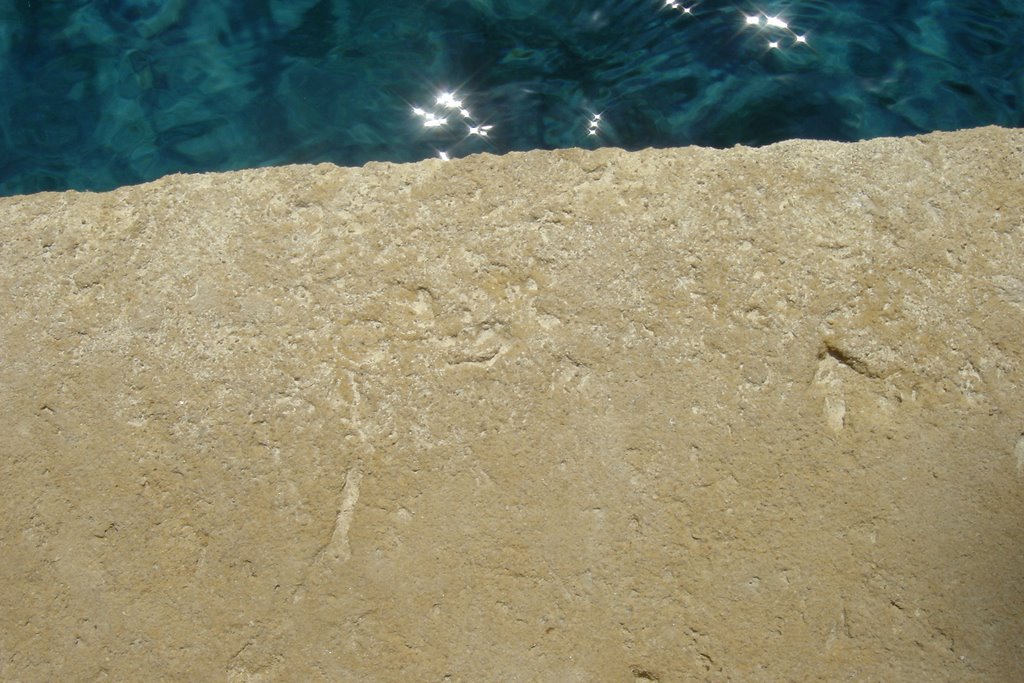
So, what does that mean? Now I may get this wrong, because like I’ve said before, I’m just a pool cleaner. And so if any of you experts in this field want to put in your two cents worth via the comments section of this blog and correct any errors, please feel free. But even pool cleaners can read, and what I get from reading the text that supports this page is that when salt enters stone or concrete in a strong enough concentration, that it will begin to crystallize, causing “crystallization expansion”, exerting pressure on that stone or concrete. It results in damage like you see in the picture that accompanies this post. That picture is of a type of stone called silver mist. It seems to be somewhere between a sandstone and a flagstone - like Pennsylvania blue - in density. That stone was put in six months before the picture was taken. And the damage done to it is called “roof jacking” which is a different phenomenon that what I’ve seen with limestone and sandstone, where they just disintegrate.

Now, lets’ go back to what those manufacturer’s reps always tell us about why all of this is impossible. We’re only putting 3,000 to 4,000 parts per million (ppm) in pools, and salt isn’t corrosive in those concentrations. And even Winkler says that you need 36 grams per 100 milliliters of water for halite to start to crystalize at temps above freezing. That’s 360 grams per liter, and that’s 360,000 ppm. So, it would appear that they have a point, right?

But most of the damage occurs where water splashes out onto the stone or concrete. The water evaporates, but the salt is left behind, inside the stone. The next splash deposits another 3,000 to 4,000 ppm. And the next. And the next. So, in about a year, you have heavily saturated stone and concrete. About 36 grams per 100 milliliters, in fact. Enough for crystallization to begin and the damage to start.

But it gets worse. Winkler also points out that at temps below freezing, NaCl crystallizes as hydrohalite. “The crystallization of hydrohalite below freezing point can much accelerate the decay process of stone surfaces... despite much lower crystallization pressures than for halite.” That’s on page 167. Read it for yourself.

So, as you can see, we don’t even have to wait for the build up of salt through splash out if we just get one good cold snap. The hydrohalite (salty water) will freeze and burst the stone from the inside out. Just like those other science guys I quoted in my very first rant on this blog:

“The most remarkable feature of salt scaling is that the damage is absent if the pool contains pure water...(and that) ...salt scaling is a consequence of the fracture behavior of ice. The stress arises from thermal expansion mismatch between ice and concrete, which puts the ice in tension as the temperature drops.”

Winkler published his book in 1994. Most of the studies he cites in his research go back to the mid sixties. But for twelve years there’s been a definitive text out there detailing exactly what would happen to ALL STONE AND CONCRETE if you mixed salt and water.

Galvanic corrosion has been a known phenomenon since 1800, when Allesandro Volta (Volta... volts... get it?) invented the first battery.

How come a pool cleaner knows about these things and the Big Three don’t?

Because if they knew about it, they would have told you before they sold you these salt systems. Right? Wouldn’t they?

Who’s got your back now?

There’s a chill in the air. Halloween’s right around the corner. Before you know it, it’ll be winter. Are you sure you want to keep pouring that salt in those pools of yours?

And Res Ipsa Loquitur? The thing speaks for itself.

Saturday, October 21, 2006

BAD FOR THE GLASS...

When Mulwray’s Japanese gardener said that to Jake Gittes in the noir classic, Chinatown, Jake had no idea the gardener had just given him the key to unlock the secret of Mulwray’s death.

I had a similar experience this week, when someone sent me an e-mail telling me they had just attended a seminar where one of the Big Three manufacturer’s reps had let on that there might be this teensy weensy little issue called electrolysis (read galvanic corrosion) causing just the slightest amount of damage to everything metal that a salt system might touch. Everything except the titanium plates of the salt cell, of course. You see, it’s the fact that they use titanium - the fifth most cathodic metal in the galvanic series - that has set the whole galvanic corrosion ball rolling in our pools. Well, that’s not entirely fair. The titanium would be okay if it weren’t for the salt turning the otherwise harmless pool water into an electrolyte. In other words, you can install a salt cell in your pool’s plumbing. Just don’t put any salt in the water.

Anyway, the rep told the class to get some zinc balls and put them in the pump baskets. And, you know, he’s right.

Dr. Stephen C. Dexter, Professor of Applied Science and Marine Biology, says just that in an article titled Galvanic Corrosion:

“Suppose the steel member of a structure is being damaged by contact with silicon bronze. That galvanic corrosion can be stopped by connecting both metals to a third metal more anodic than either of them. According to our Galvanic Series, the third metal in this case could be magnesium, zinc, aluminum, or cadmium. In practice, and for reasons too complex to cover here, zinc works best... The zinc corrodes preferentially to both of the original members of the couple. The steel is now protected, and the zinc is called a sacrificial anode.”

http://www.ocean.udel.edu/seagrant/publications/corrosion.html

That reference also has a nice graph that shows where all the metals fall in the galvanic series. But getting back to the rep being right, for once.

It made me start remembering how most marine hulls have zincs attached to keep galvanic corrosion from occurring, and how maybe if we really did put those zinc balls into pump strainer baskets, we could put this whole galvanic corrosion thing to bed and we could all start feeling okay again about selling those salt systems. And then I could get on with complaining about the one hundred and one other things about the pool biz that just drive me up the wall.

Then it occurred to me how long they’ve been selling salt systems, and when problems first started showing up for me on my pool route. That 72 square foot stainless steel DE filter that I talked about, the one with pinhole leaks after ten months? It happened in 2001. That painted tank I talked about failing at the welds just happened last year. But that builder is an FNG, or New Guy, for those of you with delicate sensibilities, and I guess he missed a few memos from the BOHICA department.

So, then I was torn. I couldn’t decide if we ought to applaud the Big Three for finally bringing it out in the open, or lynch them for waiting so long to tell us. Because there’s only two takes you can have on it.

Either (a), they’re so thoroughly incompetent that they didn’t even Google the subject before they jumped in with both feet and started selling salt systems.

Or (b), they knew about this stuff all along.

If you chose (a), well... Thank you for playing. We have some nice parting gifts for you on your way out the door.

If you chose (b), now you’re talking. I can see you’ve got your sales and marketing hat on. Cha Ching, baby!

But I tried to push my inherent bias against snake oil peddlers out of my mind and just focus on the facts. Zinc balls might just be the answer, even if the idea was initially presented during a sales pitch. I mean, during a factory training seminar.

So, I called a good friend of mine and somewhat of a pool guru hereabouts, and ran the zinc balls idea by him.

And he said, “Great. So then all we have to worry about is damaged coping, ruined decks and the environmental issues. Right?”

It took a few seconds for the sting of his bitch slap to subside. But when it did, it was all clear to me. Mulwray didn’t accidentally drown in the ocean, like they tried to make us to believe. Mulwray was murdered in his own back yard, drowned in that damned salt pool.

Yeah... The salt is still bad for the glass, I mean grass... I knew it all along.

Those sales and marketing guys are really something. They throw us a bone like zinc balls and stand there and maybe they take a few minutes of heat from a few guys in the class who knew something was up all along. But then they expect us to roll over and be grateful for the bone and ignore the mountain of other issues left unaddressed.

Because after all, they are looking out for our best interests, right?

To quote Samuel L. Jackson, right before he blew enormous holes in Big Brain Brad, “Allow me to retort...”

Hayward cream colored DE filter tanks. First it was the tops. Then the bottoms.

Jandy first generation 90 degree turn backwash valves. O-rings? We don’t need no stinking O-rings!

Pentair Mini Max first generation Lo NOX heaters. Once a Cash Crop for every warranty man.

First generation Polaris 340's. On your mark! Get set! Go! (really fast and then stop and never move again)

Innumerable generations of Jandy temp sensors. Now they work. But how many revs did we go through before we got where we are today? That was the first time I heard the punch line, “That’s a problem. And we’re working on it.”

Jacuzzi Everything. Such a popular brand that Jacuzzi Earthworks DE filter grids are now special order from Canada.

Stop me when I tell a lie.

I hope some day I can crack wise about the fading memory of salt systems, too. Because as bad as these other problems were and as much profit as they eventually sucked out of the sale - even with warranty support from the manufacturer- they were each their own little self contained disaster.

On the other hand, salt screws up everything.

And BOHICA? It means Bend Over Here It Comes Again.

Saturday, October 14, 2006


WHY SALT SUCKS


So, do I have your attention now? Yes, I know. Cheap trick. But I’m trying to be combative here. Trying to get the juices flowing. Trying to get some FEEDBACK.

By the way, that's a picture of two year old limestone. Pretty, huh? It used to be, before the salt ate it.

Oh, and if you[re just tuning in, click on the September archive and read "salt belongs in the shaker, not the pool" first.

Is there no one out there who wants to defend these salt systems? No?

Good. I win. Remove them from all the pools and stop selling Pool Salt. God sakes. Do you believe it? Bags labeled Pool Salt.

"Our NaCl is better than the NaCl they sell at Home Depot. Sure, it costs more. But it’s better! Don’t use anything but genuine Pool Salt!"

Have we no shame?

But then, we mark up baking soda 1,000% and call it Total Alkalinity Control, so I guess we don’t. Yes, I know. It’s the box they’re paying $18.99 for. Not the 12 lbs. of baking soda inside.

I did receive one comment from my first post. Baboosa put me on to a new term; Galvanic Corrosion. And, boy, is it a duesy.

"Galvanic corrosion, often misnamed ‘electrolysis,’ is one common form of corrosion in marine environments. It occurs when two (or more) dissimilar metals are brought into electrical contact under water. When a galvanic couple forms, one of the metals in the couple becomes the anode and corrodes faster than it would all by itself, while the other becomes the cathode and corrodes slower than it would alone. Either (or both) metal in the couple may or may not corrode by itself (themselves) in seawater. When contact with a dissimilar metal is made, however, the self-corrosion rates will change: corrosion of the anode will accelerate; corrosion of the cathode will decelerate or even stop."

http://www.ocean.udel.edu/seagrant/publications/corrosion.html

Just so you know, most salt cell plates- or maybe all, I’m not sure - are made of titanium. Titanium is near the top of the chart for Cathodic metals. The cathode is the one that won’t corrode when galvanic corrosion takes place. So your salt cells are safe.

But it’s a good news / bad news kind of thing.

Copper, stainless steel and brass - or heat exchangers, filter tanks and water features, as I like to call them - are all pretty much anodic metals in relation to titanium. Remember now, the anode is the one that corrodes faster than it would if there weren’t any cathodic metals around.

You need three things for galvanic corrosion to occur. They are:

1. Dissimilar metals. We have that. Titanium salt cell plates and copper heat exchangers, for example. Or, titanium salt cell plates and stainless steel filter tanks, as another example. Or, titanium salt cell plates and brass pencil jets, or cannon jets, or high dollar sheer descents, to name a few. Brass is interesting in this scenario. It is made of zinc and copper. Copper is in about the middle of the galvanic index of metals. But zinc is all the way at the negative end, making it very susceptible to galvanic corrosion. That makes brass kind of ripe for this to happen. There’s something interesting about the titanium, too. It was chosen by the manufacturer because of it’s corrosion resistance (I read that in their sales brochure), because of it’s cathodic properties. Now, let’s add voltage to it. Does that make it more cathodic and speed up the whole process of galvanic corrosion for the anodic metals? Any science guys out there want to comment on that?

2. Electrical contact between the dissimilar conducting materials. It can be direct contact or a secondary connection such as a common grounding path. You know, like water as a grounding path.

3. Electrolyte (the corrosive medium) in contact with the dissimilar conducting materials. You know, like salt water.

Number three ought to keep any of you who thought you had me with, "then why haven’t stainless steel and copper galvanically corroded each other before salt systems came along?"

They would have. They were just waiting for the electrolyte to show up.

"Water is a compound that has strong ‘bonds’ among its constituents. In other words, it is difficult to break apart the hydrogen and oxygen atoms without some sort of energy input. ‘Salts,’ on the other hand, usually have weak ‘bonds’ and the atoms of salts can easily be separated into its appropriate ions. When a salt, like sodium chloride (table salt) is dissolved in water the sodium and chloride separate temporarily. The sodium atom will become a positively charged ion and the chloride atom will become a negatively charged ion. An ion is an atom or group of atoms that has a negative or positive electric charge. Negative ions are formed by atoms gaining electrons, and positive ions are formed by atoms losing electrons. Substances that conduct electric current are called electrolytes. They are formed as a result of a dissociation into positively and negatively charged particles called ions, which migrate toward and ordinarily are discharged at the negative and positive terminals of an electric circuit, respectively. The most familiar electrolytes are acids, bases, and salts, which ionize when dissolved in such solvents as water. Many salts, such as sodium chloride, behave as electrolytes when dissolved in water. Pure water will not behave as an electrolyte."

http://msnucleus.org/membership/html/k-6/wc/oceans/4/wcoc4_2a.html

Now, we should have known that. All of us. We should have known that the first time we poured salt into a pool we were creating a 20,000 gallon electrolyte battery.

You should have known it. I should have known it. We all should have known it.

Because if you cut and paste the link into your browser, you’ll see that the text description of electrolyte is from a fourth grade science experiment designed to teach ten year olds "that the ions in the water make salt water an electrolyte. An electrolyte is a nonmetallic electric conductor in which a current is carried by the movement of ions". In the experiment, the children observe that as they begin to add salt to the water, the water begins to conduct electricity, and the light begins to glow. The more salt they add, the more brightly the light glows.

Now that we’re all properly embarrassed, go back to the last sentence in the description of an electrolyte: Pure water will not behave as an electrolyte. Granted, our pool water is far from pure, but the old NSPI guideline limits TDS to 3000 ppm. Tap water ranges from 250 to 600 ppm. The highest I ever saw was 465 ppm out of the tap in El Cajon, CA. But I’m sure there’s harder water than that out there. The point being, we used to drain pools when they started approaching 3,000 ppm TDS. That’s where we start talking with salt systems.

Hence this discussion about galvanic corrosion. It was never an issue before. Now it is.

For example: Everybody knows by now, even those who defend salt systems, that you ought not to install a stainless steel DE filter tank where you have a salt system. I believe that more than half the reason is galvanic corrosion. I think another part is a little known issue called chloride stress corrosion, a problem unique to stainless steel, pressure, high water temp and brine, but we’ll talk about that at another time. Back when this whole salt craze started, I had a brand new pool on service that had a salt system and a stainless steel filter tank. The tank had pinhole leaks within ten months. Another one, a painted stainless steel tank (betcha can't guesswhich one) lasted a full year before it started weeping at the welds.

On the other hand, I have pools on service that are so old that a few still have American Products Titan stainless steel DE filters, but no salt system. Twenty years later, the tanks are just fine.

When you rule out stainless steel filter tanks, you automatically rule out 72 square foot DE filters and give up 12 square feet of filtration area. Because the largest non-corrosive DE filter tank is 60 square feet.

Now, if you’re a good and conscientious builder, you know that anything larger than a 2 horsepower pump will eventually crush those grids, and in some installations, even just 2HP is going to cause premature deterioration of the grid pack.

But your customer is adamant about having a salt system - because his best buddy does and the water feels so totally cool - and at the same time he really wants those spa jets to sing and dance, and you’re trying to squeeze in all the water features that he wants on that single filter pump and still keep your bid right so that you don’t lose the work to the competition who doesn’t care about pump and filter sizing.

Of course, if you take salt out of that equation, the problem goes away.

Further, I believe that the recent attempt to introduce cartridge DE filters - where you can get up to 100 square feet of DE filter area in a plastic tank - has been driven by the problem of salt and stainless steel.

Talk around the campfire is that we are probably in for a bit of a wait before they get the kinks worked out of cartridge DE filters.

Once again, though, the way we’re finding out that there’s a problem is by buying them, selling them, installing them and then spending all of our profit on complaint and problem calls, not to mention being totally defenseless when the customer asks, "didn’t you check this thing out at all before you sold it to me?"

But the salesman said...

At least with something like a filter problem, the worst case scenario is installing a different filter and a little bit of vacuuming to suck up the DE that blew into the pool when the cartridges crushed.

With salt, and a litigious consumer, you’re looking at the possibility of being on the hook for failed filter tanks, crushed grid packs, salt damaged coping and decks, failed copper heat exchangers, deteriorating brass water features that put metals into the pool water that will eventually plate out, and subsequent acid washes or replastering. High concentrations of salt will also kill trees and most any other type of vegetation and erode the soil (see my first post: salt belongs in the shaker, not in the pool). If you’re the one that installed the sticky water leveler and the salt system, are you liable for the damages?

Or maybe we should just sell them where they’re appropriate. You know, like for a pool that uses no concrete (salt water freeze/thaw issues), or stone (deterioration issues), or metal (galvanic corrosion issues), or is surrounded by soil, or plants or trees (environmental issues), or backwashes to the sewer (waste treatment salinity issues), or backwashes to the street (once again, environmental issues), or ever has to be drained to the sewer or the street (the same waste treatment and environmental issues).

We can, of course, just keep selling salt systems, and when things go south, keep walking away. That seems to be most folks answer. Because the truth is most customers don’t litigate. They just say bad things about us until they die. But it seems like these kinds of things just keep happening over and over and over again in our industry. Things like that first generation salt system that used to blow up if you left it unattended for too long, or the ionizers that turned pools copper green and purple, or pencil thin filter tank clamps that aged and blew the lids off and into people’s faces, or single source drains in spas, or... do I need to go on?

Maybe that’s why most homeowners and the other trades look at us like the Corky’s of the construction and service industries.

Maybe if we stop letting greed and avarice cloud our minds, and maybe if we stop looking to the manufacturers for pat answers instead of fixes, and maybe if instead we ask more hard questions up front before we buy to resell...

Yeah, right. And maybe bats will fly out of my butt.

Friday, September 08, 2006

Salt belongs in the shaker. Not in the pool.

I've had it up to here (imagine me reaching about a foot over my head) with these manufacturers telling us what a boon to the pool biz these salt systems are.

Hello? Has anyone noticed what it does to limestone? Travertine? Sandstone? Concrete? Diving board stands? Stainless steel filter tanks? Those little brass handles on the skimmer baskets? Brass pencil jets?

Has anyone noticed how the stainless steel teeth on Polaris 280 drive shafts are eaten down to rusty little nubs in salt pools but not in tablet pools?

Has anyone noticed how filter tank warranties have gone from the typical ten year full or prorated to one year?

Has anyone noticed how every time it rains, if your pool has a tile line drain, your humping salt out to all your pools the next week? Where do you think that salt’s going? But more about that later.

The really hard part to swallow is that the manufacturers aren't admitting any of these problems exist. One time, I asked a manufacturer's rep why didn't he at least tell builders they ought not to sell a salt system on certain pools. We were standing in one of my customer's backyards, looking at one year old decomposing limestone coping at the time.

And this is what he said:

"How can I tell them not to sell a salt system when I don't believe that salt caused this damage. You see, salt is only corrosive at levels above six thousand parts per million and our system only uses around three thousand parts per million. So, to my way of thinking, it's impossible that salty water caused this damage."

I said to him, "We recently discovered this phenomenon that we call evaporation, wherein water, splashed out of a pool onto, say, limestone coping, will actually disappear, leaving it's mineral content behind. Now, we suspect the Sun is the culprit, as the rate of this phenomenon seems to decrease when the Sun Chariot goes behind the hills beyond the edge of town for the night. In the Olden Days, when the magical evaporation occurred, the worst thing we ever saw as a result of the minerals left behind was a chalky white calcium stain.

"But then, we added salt to the mix, and after the water evaporates, the three thousand parts per million salt level is magically transformed to one million parts per million, slightly in excess of the six thousand parts per million you say we need to damage the stone am I going slow enough I realize you're a salesman and so can only speak and not listen but perhaps you can read my lips or think about something besides dollar signs and I've always wondered how do you people lay your head down and sleep at night and what's it like to tell lies for a living and did it ever occur to you to put a moments thought into the handy answers your company feeds you to overcome sales resistance and customer dissatisfaction when a year after your product is installed it's caused upwards of ten thousand dollars worth of damage to a sixty thousand dollar swimming pool and don't you have a decent bone in your body or even a hint of a sense of responsibility to the homeowners, or failing that, to the builders you conned into selling these Trojan Horses along with their otherwise beautiful custom built pools?"

And he smiled and slapped me on the back and said, "Hey, I'm really glad we were able to get together today and brainstorm about this problem your customer is having. It's always such a pleasure talking to you and I'm so glad I was able to come here today and make a difference. Come on and follow me out to my truck. I want to give you some free parts to shut... I mean, to show my appreciation for choosing our products for your customers and to give you some of our brochures about the exciting things we have planned for next season. Real win-win products, because they’re great profit centers for you, and, just like that salt system, wonderful new inventions guaranteed to enhance your customers swimming experience. Like the jagged glass ring toss game that we’re test marketing for next year. I’d like to give you a couple to pass on to some of your better customers...”

Now, I’m just a pool cleaner and repairman. I don’t have the advanced degree in basket weaving or canoeing that is required to even fill out an application for a sales job at most of the Big Three pool manufacturers. But I got tired of watching my pools fall apart and listening to sales reps tell me that the only problem here is that I’m a child of the sixties and, well... you know.

So, I started doing a little research into the possibility that someone out there just might know some of the reasons why I was seeing such heavy damage to so many of my salt pools.

I was bowled over by what a night of Googling revealed.

For example, did you know that:

“Over the past 60 years, concrete infrastructure in cold climates has deteriorated by ‘salt scaling,’ which is superficial damage that occurs during freezing in the presence of saline water. It reduces mechanical integrity and necessitates expensive repair or replacement. The phenomenon can be demonstrated by pooling a solution on a block of concrete and subjecting it to freeze/thaw cycles. The most remarkable feature of salt scaling is that the damage is absent if the pool contains pure water...(and that) ...salt scaling is a consequence of the fracture behavior of ice. The stress arises from thermal expansion mismatch between ice and concrete, which puts the ice in tension as the temperature drops. Considering the mechanical and viscoelastic properties of ice, it is shown that this mismatch will not cause pure ice to crack, but moderately concentrated solutions are expected to crack. Cracks in the brine ice penetrate into the substrate, resulting in superficial damage.”

http://www.ingentaconnect.com/search/article?title=Salt+damage&title_type=tka&year_from=1998&year_to=2006&database=1&pageSize=20&index=17

Oh.... so that’s why the stamped concrete around my customer’s eight pencil jet water features is deteriorating. You see, the first winter after the pool was built, the freeze guard was running the water feature pump every time we got a cold snap. Then, the wind would blow a little bit of the water onto the deck, where it would pool around the base of the brass pencil jets, penetrate the more lightly coated stamped concrete there and cause the damage just like the damage cited in the research study.

On the one hand, I’m just a pool cleaner. I’m sure the builder and the salt system manufacturer thought about all that beforehand and I’m just hallucinating again. And, of course, I have an axe to grind with the builder and manufacturer for screwing my customers like stump-tied sheep. I admit. I’m biased.

On the other hand, the scientists, Dr Scherer and Dr. Valenza, the guys who wrote this research article for The Journal of the American Ceramic Society, have some pretty hefty credentials. Like the Princeton Institute for the Science & Technology of Materials, Department of Civil and Environmental Engineering, Princeton, New Jersey.

Gosh... who should I believe? The guys with the degrees in basket weaving - with a minor in business, of course - or the scientists from Princeton?

Then there’s the article titled “Salt-induced decay in calcareous stone monuments and buildings in a marine environment in SW France”, by a group of six scientists from universities and institutes from Antwerp to Athens to La Rochele, France. The research article matter-of-factly states that “salt-induced deterioration of architectural heritage is considered to be accelerated drastically in marine environments”.

http://www.sciencedirect.com/science?_ob=ArticleURL&_udi=B6V2G-47GY6FP-2&_coverDate=04%2F30%2F2003&_alid=463004100&_rdoc=1&_fmt=&_orig=search&_qd=1&_cdi=5702&_sort=d&view=c&_acct=C000050221&_version=1&_urlVersion=0&_userid=10&md5=85c8a8122b9ddf50f40d10d1708134f2

Hmmm... decaying stone... salt-induced... marine environment... What could they be saying? It must be some secret language that only scientists can understand. Certainly the salt, or NaCl, that’s in these marine environments is wholly different from the salt, NaCl, that we dump into swimming pools.

I know. Let’s go to www.saltinstitute.org and ask them.

Wait... what’s this? There appears to be a photo on their home page of salt being harvested from sea water through solar evaporation. Hmmm... I wonder? Could it be that the salt system manufacturers forgot to mention fifty or sixty years of research that proves conclusively that salt hastens the destruction of stone and concrete structures?

But then there’s the article, “The evaluation of crystallization modifiers for controlling salt damage to limestone”.

Ahah! Herein lies hope. These are a couple of different science guys who are talking about adding something to the salt to “significantly affect the capillary passage of dilute and concentrated solutions of sodium chloride and sodium sulfate through columns of limestone.” In other words, reduce the damage of salt on limestone.

They clearly state that “sodium chloride passage through Monks Park limestone gave predominantly subflorescence with mild edge erosion while sodium sulfate mainly effloresced and severely damaged the stone column”.

http://www.sciencedirect.com/science?_ob=ArticleURL&_udi=B6W6G-46MC6NV-8&_coverDate=09%2F30%2F2002&_alid=463204831&_rdoc=1&_fmt=&_orig=search&_qd=1&_cdi=6598&_sort=d&view=c&_acct=C000050221&_version=1&_urlVersion=0&_userid=10&md5=4e06656a402303c85c8bd33fa4463c9d

So, the answer is easy. Just put this additive in with our salt... what is it this wonder additive? Oh, yes, potassium ferrocyanide... Hey, wait a minute. I read somewhere else that they’re already putting sodium ferrocyanide into most road salts and:

“under acidic conditions...this compound is known to break down, generating toxic cyanide forms, including hydrogen cyanide. These toxins appear to have caused serious fish kills as the result of sodium ferrocyanide’s use by the BC Ministry of Forests in fire retardants. Recent animal studies also have shown chronic cyanide exposure may be deleterious to liver and kidney functions and causes both time- and dose-dependent DNA fragmentation, accompanied by cytotoxicity.”

http://www.elements.nb.ca/theme/transportation/salt/salt.htm

Maybe not what you want your kids swimming around in, after all.

But while we’re on the subject of road salt:

“The corrosion and environmental costs pertinent to road salts amount up to at least $469 per ton on average, and they are often ignored in formulating highway winter maintenance strategies. The magnitude of such hidden costs is significant compared with the nominal cost of using road salts for snow and ice control...”

http://www.coe.montana.edu/wti/wwwshare/Corrosion/Highway_Winter_Mainteance_Asset_Management.pdf

A ton of road salt only cost about $75.00, or about 15% of that $469.00 a ton. The rest is infrastructure cost. Infrastructure like cars, roads, bridges, the environment. In the US we use about ten million tons of road salt per year. Do the math. That’s $4,690,000,000 a year. If you subtract out the cost of the salt, that means that $3,940,000,000 damage results from road salt.

But I’m sure it won’t hurt your pool, or your coping, or your deck, or your metal water features, or your stainless steel filter tank, or your diving board stand, or the ground around your swimming pool. You see, my salt system salesman told me so. And you can take that to the bank. After all, he did.

Then I read:

“Sodium exchanges easily with calcium and magnesium in soil, as well as other nutrients needed for soil fertility. This process destroys soil structure and fertility. Long-term salt accumulation can cause high soil density and low permeability, which adversely affects plant growth and erosion control.”

http://sci.cfans.umn.edu/StudProj/5061Mangold.pdf

You know, that's how water softeners work. They leach the calcium and magnesium out of your water and replace it with sodium. Isn't that great?

Also, think about sodium's effect on your soil the next time you do a cannon ball into the pool. What’s all that salt in the splash water doing to the flower beds? To the grass? To the trees?

Funny story here. Unfortunately, not funny haha. Funny like I wished I could have crawled into a hole when it happened.

Imagine you’re looking out a huge picture window. In the foreground, there’s a beautiful negative edge pool. The edge of the pool appears to waterfall over onto a tree covered hillside gently sloping away from you. There are several trees on this hillside, but the largest and oldest, a huge pecan tree, is smack in the middle of your view, as if this whole project, this whole house and pool and terraces were built centered on that tree’s magnificent canopy.

They were.

The water in the negative edge pool doesn’t really flow down the hillside. That’s the illusion. It drops into a trough about six feet below the edge of the pool. That’s where the auto water fill for the pool is installed. When the negative edge pump turns on, it pump water up from the trough, overfilling the pool and creating that illusion. The auto water fill kicks on as the trough drains to make up for any water lost since the last time the negative edge pump was run.

Now, add a salt system. Everything’s fine - except for the water splashed as it falls from the pool into the trough that’s impregnating the ground around the trough with salty water so that no grass grows. But other than that, everything’s fine.

Then the auto water fill gets stuck open. Now the trough overflows. The pool keeps waterfalling salty water into the trough so the water running down the hill has a slowly decreasing saline content. This is about a 40,000 gallon pool, so that’s quite a bit of salty water. If you just poured the undiluted salt granules onto the hillside it would be 1,334 lbs. of salt. Say that to yourself slowly. One thousand three hundred thirty four pounds of salt. Nearly twenty-seven 50 lbs. bags.

But we weren't pouring undiluted salt granules onto the hillside. We were giving the salt the single mechanism it needed to penetrate the ground and saturate the roots of that beautiful pecan tree. We gave the salt water.

Yes. That salt pool killed that magnificent pecan tree. That’s what the arborist said, anyway. He didn’t even know that you could chlorinate a pool with salt when he rendered his opinion, and was pretty well baffled by the idea that a mighty pecan had been felled by salt in Dallas, Texas, several hundred miles from the nearest marine environment and about that far again from any salted winter roads.

That was my first clue that maybe there were going to be “issues” with salt systems.

Think about a good hard rain. You know, the ones where your weatherman says you got a couple or three inches of rain in twenty-four hours. And the pool never overflows because the builder’s a sharp guy who installs tile line drains in all his pools.

Wherever that tile line drain comes out just got about 1,000 gallons of salty water, or about 35 lbs. of salt.

There are so many studies that show significant damage to trees and shrubs and soil from salt. Just google salt damage and plants or trees or soil and you’ll see hundreds of returns of university studies, federal state and local studies, environmental legislation, and more and more and more, all dealing with the down side of too much salt.

If that’s not enough, here’s another one:

http://www.lacsd.org/chloride/default.asp?cid=1

The Santa Clarita Valley Sanitation district became concerned because the salinity of the water rose from 129 milligrams per liter in 1997 to 168 milligrams per liter in 2001. The 129 was already far in excess of the 100 milligrams per liter maximum established by the state of California.

The main culprit of this additional salinity was traced back to water softening systems installed in less than 10% of the homes in the water district. So, they banned water softening systems.

Then in November, 2005 they banned any saltwater pools that were connected to the sewer system. In other words, any system that backwashes to the sewer. Salt systems require between 3 and 4 grams per liter to operate. That’s 3,000 to 4,000 milligrams per liter, or thirty to forty times the maximum established by the state of California for potable water. So, you can see why they were concerned.

http://www.lacsd.org/chloride/default.asp?cid=44

Now, if they passed that law here in Dallas, Texas, just about every pool with a DE or sand filter would be affected. Because they’re all supposed to be plumbed to the sewer to meet code. In California, though, they’re not required to be plumbed to the sewer. At least according to this guy:

http://www.castaicpools.com/article6.htm

This guy, Harry Clay, isn’t worried about the amount of chloride in the water supply. He’s worried about being able to keep selling them salt systems. And I quote; “With no previous discussion, or input from the swimming pool industry, [editor's comment: industry input? Isn’t that kind of like asking Enron to help the government establish energy policy? Oh, wait a minute. They already did that.] this controversial bombshell caused quite a bit of shock among builders, manufacturers, & salt water pool owners for a few days, until the legs were cut off this ill advised ordinance. The key words to this poorly thought out ruling are ‘Pools connected to the sewer system’. Virtually no pools have been built in Santa Clarita that are in fact, connected to the sewer system.”

You see, Harry’s proud of the fact that in California, they can spray their backwash effluent directly onto the ground. Even though the research shows that “long-term salt accumulation can cause high soil density and low permeability, which adversely affects plant growth and erosion control”.

Because, truth is, most backwash hoses get rolled out to the same spot every time they’re used. So that salty water gets deposited in the same spot every time the pool is backwashed. Too, since they don’t have to plumb to the sewer, they drain pools pretty much wherever they want to out there, depositing anywhere from 500 to 1,000 lbs of salt onto the soil at the end of that drain hose.

Even if they put that hose in a storm sewer, it eventually ends up flushing into a creek or a river, which in turn damages vegetation and the soil.

But Harry’s only concern about putting the salty water in the storm drain is that “storm drains do not run thru the sewer system & are not under the jurisdiction of the Sanitation District”.

Pretty much Harry’s real concern about this “ill advised ordinance” seems to be finding a way to cut the legs off of it, so he can keep selling them salt systems. After all, why should he give a rip about his neighbor’s water quality when there’s money to be made? And besides, he's successful. He and his customers can easily afford the $500 a month water bills the Santa Clarita Water District is predicting if they have to update their equipment to remove the ever increasing levels of sodium in the water. The folks who might have trouble ponying up that much each month aren't in his customer base, anyway.

And I think that’s the thing that bothers me the most about these salt systems. There’s lots and lots of Harry’s out there. Guys who are more than happy to spread misinformation about salt systems for the few bucks they make when they sell them. Misinformation like, “the owners of the technologically superior Salt Water / Saline purified pools don’t flush or backwash their pools nearly to the degree that owners of older pools with the old fashioned chlorine floaters do”.

Honestly, have you ever read anything more ridiculous in your life? No? Then read this; “With the newer Salt Water Purification Systems, we’re using Electrolysis to Oxidize combined chloride molecules & to kill algae & bacteria.”

It’s pretty clear that old Harry doesn’t even know how salt systems work, or when to capitalize in a sentence. He’s turned electrolysis into a sanitizer, instead of what it is in this case; the mechanism that turns a chloride ion into chlorine gas, which dissolves in the water to form hypochlorous acid, the killing form of chlorine.

And the other thing that bothers me is that after all the years of manufacturers and builders ignoring the down side of these salt systems, they continue to stonewall and obfuscate, even as these chickens come home to roost on each and every one of us, as we try to explain to our customer why their pool is falling apart so much faster than their neighbor's pool who doesn’t have a salt system.

Because you already know what the manufacturer and the pool builder are going to say, don’t you?

“It must be your poolman’s fault.”